

Shar-Pei
Other Names: Chinese Shar-Pei
Country of Origin: China
Accreditation:
American Kennel Club (AKC): Non-Sporting
Canadian Kennel Club (CKC): Non-Sporting
United Kennel Club (UKC): Northern Breed
Australian National Kennel Council (ANKC): Non-Sporting
The Kennel Club (KC): Utility
Kennel Union of Southern Africa (KUSA): Utility
National Kennel Club (NKC): Recognized
New Zealand Kennel Club (NZKC): Non-Sporting
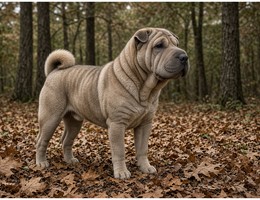
The Shar-Pei is known for his distinctive features of deep wrinkles, and a blue-black tongue. His muzzle, shaped like a hippopotamus, along with his small, triangular ears, and a high-set tail, also give the Shar-Pei his unique look. Shar-Pei usually come in two varieties. One variety, called the Western type, is covered in large folds of wrinkles, even into adulthood. The other variation, the original type, has skin that appears tighter on its body, with wrinkles just on the face and at the withers. As a puppy, the Shar-Pei has numerous wrinkles, but as he matures, these wrinkles disappear as he "grows into his skin". One of the most intriguing features of the Shar-Pei, is that if you grab him by any loose wrinkle, he can actually twist in his skin, and face in your direction.
A short-coated house dog with a wrinkled outline; little grooming, a reserved voice with strangers, and a better fit in a calm house than in heat or chaos.
- Height
- 18-20 inches
- Weight
- Male: 55-65 pounds; Female: 40-55 pounds
- Color
- Black, cream, fawn, red-fawn, red, sable, apricot, chocolate, Isabella, or blue
- Coat
- Brush-coat, with long hair and a smooth feel; or horse-coat, rough to the touch, extremely prickly and off-standing, in one direction soft, in the other harsh
- Lifespan
- 8–12 years
- Litter size
- 4–6 puppies
Temperament
Training
Care and grooming
Shedding
Health
Crosses that include the Shar-Pei
These hybrid pages list this breed as a parent. Open a name to see the other contributing breed.
EIW.com Copyright © 2003 - 2026 All Rights Reserved
EIW.com accepts no responsibility for the accuracy of the advertisements placed on the EIW.com website or for the contents of any website to which a hypertext link from EIW.com links. The Seller Ads and links to products and/or services are provided as a service, and EIW.com gives no warranties, expressed or implied, about the information and/or policies of the Seller Ads or the linked-to webites, or of the information shown.
EIW.com is the sole owner of the services and of all information provided by and posted to the EIW.com website. The use, reproduction, or storing of content for any purpose other than to contact a Seller, purchase a product or service, or compare prices is prohibited. You cannot use the information provided by EIW.com to recreate a directory, rebrand the informaton or redistribute the information in any way. Information provided by EIW.com is for individual, non-commercial use only. All information, processes and content contained within and that make up the services are the sole property of EIW.com. You may not reproduce, duplicate or redistribute any information provided by EIW.com for profit or personal gain of any kind. You may not frame any content or pages contained within the EIW.com website unless expressly granted permission by EIW.com.