

Australian Shepherd
Other Names: Aussie Shepherd
Country of Origin: United States
Accreditation:
American Kennel Club (AKC): Herding
Canadian Kennel Club (CKC): Herding
United Kennel Club (UKC): Herding Dog
Australian National Kennel Council (ANKC): Working Dogs
The Kennel Club (KC): Pastoral
Kennel Union of Southern Africa (KUSA): Herding
National Kennel Club (NKC): Recognized
New Zealand Kennel Club (NZKC): Working Dogs
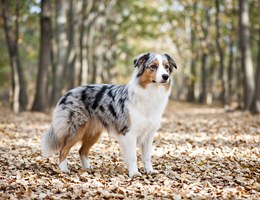
The Australian Shepherd is a Medium, with medium bone structure, and slightly longer than he is tall. His appearance demonstrates strength and stamina, combined with unusual agility, and with well–defined masculinity or femininity. His muzzle tapers slightly to a round tip, and his almond–shaped eyes are brown, blue, amber, or any variation of combination including flecks and marbling. He may have two different colored eyes, or have bicolored or "split eyes", such as half–brown and half–blue. His triangular–shaped ears are set high at the side of his head, and are slightly rounded at the tip. Some Aussies are born with naturally short bobbed tails, others with full long tails, and others with natural partial bobs, where the tail is mid–length and appears stubby.
A herding dog for an active house and yard: a coat that sheds, a watchful bark, and a mind that invents trouble when it has no job.
- Height
- Male: 20–23 inches; Female: 18–21 inches
- Weight
- Male: 55–70 pounds; Female: 35–55 pounds
- Color
- Black, red (sometimes called liver), blue merle (marbled black and gray), and red merle (marbled red and silver or buff); with or without copper points and/or white markings in various combinations on the face, chest, and legs; a black or red dog with copper and white trim is called tricolor or tri, a black or red dog with white trim but no copper is called bicolor or bi
- Coat
- Double; moderate length and coarseness; medium texture, straight to slightly wavy; weather resistant; moderate mane and frill; quantity of undercoat varies with climate
- Lifespan
- 12–15 years
- Litter size
- 6–8 puppies
Temperament
Training
Care and grooming
Shedding
Health
Crosses that include the Australian Shepherd
These hybrid pages list this breed as a parent. Open a name to see the other contributing breed.
EIW.com Copyright © 2003 - 2026 All Rights Reserved
EIW.com accepts no responsibility for the accuracy of the advertisements placed on the EIW.com website or for the contents of any website to which a hypertext link from EIW.com links. The Seller Ads and links to products and/or services are provided as a service, and EIW.com gives no warranties, expressed or implied, about the information and/or policies of the Seller Ads or the linked-to webites, or of the information shown.
EIW.com is the sole owner of the services and of all information provided by and posted to the EIW.com website. The use, reproduction, or storing of content for any purpose other than to contact a Seller, purchase a product or service, or compare prices is prohibited. You cannot use the information provided by EIW.com to recreate a directory, rebrand the informaton or redistribute the information in any way. Information provided by EIW.com is for individual, non-commercial use only. All information, processes and content contained within and that make up the services are the sole property of EIW.com. You may not reproduce, duplicate or redistribute any information provided by EIW.com for profit or personal gain of any kind. You may not frame any content or pages contained within the EIW.com website unless expressly granted permission by EIW.com.